
Wound healing is one of the oldest and best-documented applications of photobiomodulation. The research spans four decades, multiple wound types, and dozens of RCTs. Here’s what we know.
New to photobiomodulation? Explore the complete Red Light Therapy Guide covering wavelengths, dosing, treatment distance, near infrared light, and how modern red light therapy panels work.
Why Light Accelerates Healing
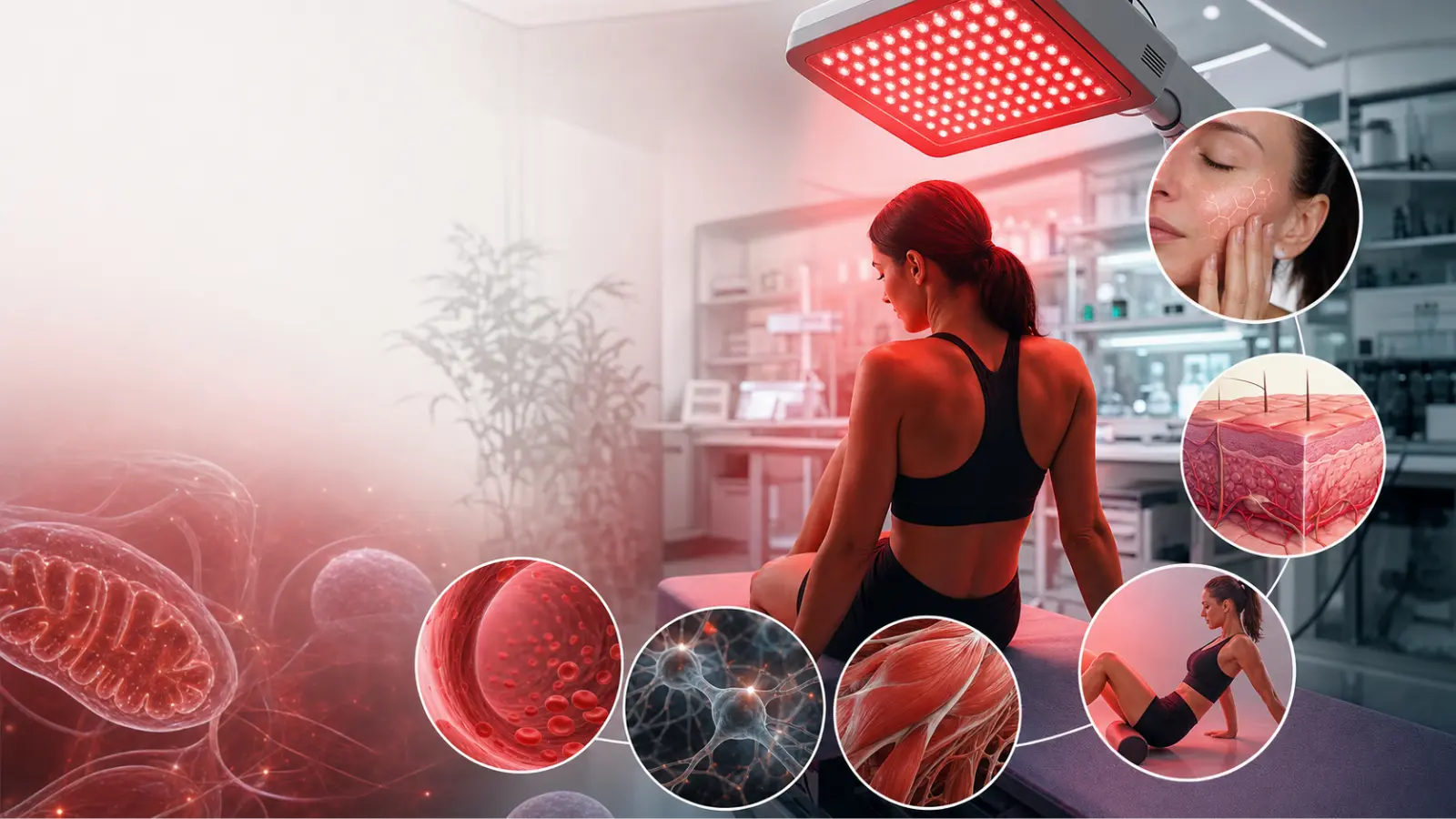
Wound healing involves three overlapping phases: inflammation, proliferation, and remodelling. Red and near-infrared light accelerate all three. In the inflammation phase, PBM reduces excessive inflammatory cytokines and ROS that delay healing. In the proliferation phase, it stimulates fibroblast activity (collagen production) and angiogenesis (new blood vessel formation). In the remodelling phase, it enhances collagen crosslinking, improving scar strength and tissue quality.
Clinical Evidence
Best Wavelengths for Wound Healing
For superficial wounds, 630–660nm red light is most effective — it penetrates to the depth of the dermis and directly stimulates fibroblasts and keratinocytes. For deeper wounds (post-surgical, muscle injury), 830–850nm NIR penetrates further and stimulates deeper tissue regeneration.
| Wavelength Range | Common Application | Primary Target |
|---|---|---|
| 630–660nm Red Light | Superficial wounds and skin recovery | Dermis, fibroblasts, keratinocytes |
| 830–850nm Near Infrared | Deeper wounds, post-surgical recovery, muscle injury | Deep tissue regeneration and recovery |
The MitoPRO 1500X covers both ranges. For users dealing with chronic or complex wounds, the broader spectrum of the MitoADAPT MAX 4.0 provides additional wavelength options including 670nm, which has shown particular promise in fibroblast stimulation studies.
Protocol Guidelines
Treatment protocols for wound healing vary depending on the device, wavelength, power output, and wound type. In many studies, red light therapy is applied several times per week at close range for short sessions targeting the affected area directly. Superficial wounds are commonly treated with red wavelengths in the 630–660nm range, while deeper tissue injuries may benefit from near-infrared wavelengths around 810–850nm due to greater tissue penetration.
For best results, follow manufacturer guidelines and consult a healthcare professional for serious wounds, diabetic ulcers, or post-surgical recovery. Avoid shining high-intensity light directly into the eyes and discontinue use if irritation occurs.
Treatment Frequency → Often several sessions per week in clinical studies
Session Style → Short treatments at close range targeting the affected area
Superficial Wounds → Commonly treated with 630–660nm red light
Deeper Tissue Injuries → Often studied with 810–850nm near infrared wavelengths
Safety Reminder → Follow device guidelines and consult a healthcare professional for serious wounds or medical concerns
The Bottom Line
Wound healing is among the most extensively studied applications of photobiomodulation (PBM). Research suggests that red and near-infrared light may support tissue repair by influencing inflammation, circulation, collagen production, and cellular energy metabolism. While clinical outcomes vary across studies and protocols, the overall evidence base is promising — particularly as an adjunct to standard wound care and recovery practices.
Medical Disclaimer: The information in this article is intended for general wellness and educational purposes only and is not medical advice. Research on red light therapy and photobiomodulation is ongoing, and individual results may vary. Always consult a qualified healthcare professional regarding wounds, injuries, or medical conditions.
Affiliate Disclosure: Some links on this page are affiliate links. If you purchase through them, we may earn a small commission at no extra cost to you. We only recommend products we have independently evaluated.
FAQ
Research References
Mechanisms and applications of the anti-inflammatory effects of photobiomodulation https://pmc.ncbi.nlm.nih.gov/articles/PMC5523874/
Low-level light therapy for wound healing: mechanism and efficacy https://pmc.ncbi.nlm.nih.gov/articles/PMC4148276/
Photobiomodulation therapy for diabetic wound healing review https://pubmed.ncbi.nlm.nih.gov/33870502/
Influence of low level laser therapy on wound healing and its biological action upon myofibroblasts https://pubmed.ncbi.nlm.nih.gov/12605432/
Photobiomodulation in fibroblasts: from light to healing through molecular pathways https://www.frontiersin.org/journals/bioengineering-and-biotechnology/articles/10.3389/fbioe.2025.1675619/full