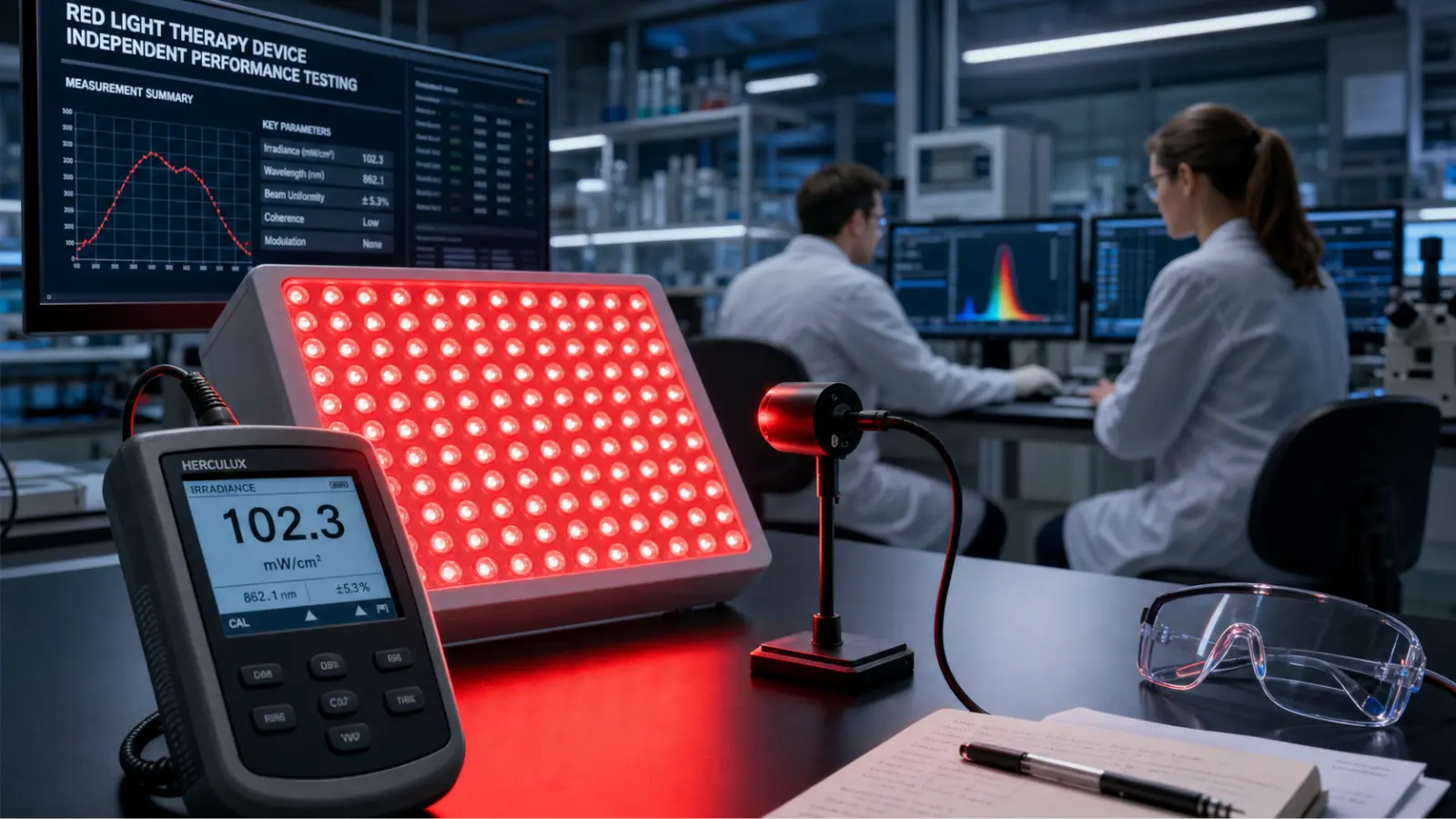


The idea that light could influence mood and brain function may sound unconventional, but transcranial photobiomodulation (tPBM) has become a growing area of neuroscience research over the past decade. Researchers are investigating whether specific wavelengths of near infrared light can influence brain metabolism, inflammation, and neural activity in ways that may support mood and cognitive health.
Quick Answer
Early research suggests transcranial photobiomodulation (tPBM) may help support mood and cognitive function in some individuals, particularly in depression research. Most studies remain small and preliminary, but near infrared wavelengths such as 810nm and 1064nm are being actively studied for their potential effects on brain metabolism, inflammation, and neural signaling.
The Mechanism: Light, Mitochondria, and the Brain
Some near infrared wavelengths, particularly around 810nm and 1064nm, appear capable of penetrating scalp and skull tissue sufficiently to influence superficial cortical regions in experimental settings. Much of the research has focused on the prefrontal cortex, a brain region heavily involved in mood regulation, emotional processing, and executive function.
Researchers believe photobiomodulation may influence brain tissue through several mechanisms, including support for mitochondrial ATP production, modulation of oxidative stress pathways, changes in cerebral blood flow, and broader effects on inflammatory signaling and cellular communication pathways.
Although the exact mechanisms are still being studied, the biological rationale for transcranial PBM is considered plausible within neuroscience research.
Clinical Evidence for Depression
Early human studies investigating transcranial photobiomodulation for depression have produced encouraging, though still preliminary, findings.
A 2018 study published in Behavioral and Brain Functions by Cassano et al. explored the use of 1064nm near infrared light in patients with major depressive disorder and reported reductions in depression rating scale scores with good tolerability and no serious adverse effects.
A separate pilot randomized controlled trial published in European Psychiatry investigated 810nm transcranial photobiomodulation in patients with major depression and reported clinically meaningful reductions in depressive symptoms, with some benefits persisting at short term follow up.
What Current Depression Research Suggests
- Early studies report improvements in depressive symptom scores in some participants
- Most depression studies use near infrared wavelengths such as 810nm and 1064nm
- Reported side effects in clinical studies have generally been mild
- Most trials remain small and short-term
- Larger randomized controlled trials are still needed before standardized protocols can be established
| Study | Focus |
|---|---|
| Cassano et al. Review | Mechanisms and early clinical evidence for transcranial photobiomodulation in depression |
| ELATED Pilot Trial | Pilot clinical trial investigating tPBM for major depressive disorder |
Clinical Evidence for Anxiety
The anxiety literature is smaller than the depression research but continues to expand. Animal studies have consistently reported anxiolytic-like effects following near infrared photobiomodulation, while preliminary human studies have suggested possible reductions in state anxiety following prefrontal tPBM treatment.
Researchers believe these effects may involve changes in inflammatory signaling, mitochondrial function, oxidative stress pathways, and cerebral blood flow, although the exact mechanisms remain under investigation.
What Current Anxiety Research Suggests
- Human evidence remains limited and exploratory
- Most studies focus on prefrontal near infrared stimulation
- 810nm and 1064nm are among the most commonly studied wavelengths
- Some preliminary studies report reductions in anxiety-related measures
- More high quality clinical trials are needed
What Wavelengths Are Used?
Transcranial PBM research primarily uses 810nm and 1064nm. These wavelengths have sufficient penetration depth to reach cortical tissue — shorter wavelengths like 660nm are largely absorbed before reaching the skull.
The PlatinumLED BIOMAX is one of the few consumer panels to include both 810nm and 1060nm in its 7-wavelength array, making it suitable for users exploring transcranial applications. Its high irradiance and ease of use make it ideal for treating large areas of the body and head.
Commonly Studied Wavelengths
| Wavelength | Common Research Focus | Notes |
|---|---|---|
| 810nm | Depression, cognition | One of the most studied tPBM wavelengths |
| 850nm | Brain and recovery research | Common in multi-wavelength devices |
| 1064nm | Neuromodulation and depression | Greater tissue penetration potential |
| 660nm | Mostly superficial applications | Less commonly used for transcranial PBM |
Most transcranial PBM research focuses on near infrared wavelengths because they appear capable of penetrating tissue more effectively than visible red light. Shorter wavelengths such as 660nm are generally absorbed more superficially within the skin and scalp.
Some consumer red light therapy devices include wavelengths commonly studied in transcranial PBM research, although consumer panels have not been clinically validated for treating depression or anxiety disorders.
Important Caveats
The transcranial PBM literature for mood disorders is still early-stage. Most studies involve relatively small participant groups, and researchers are still working to establish optimal dosing protocols, treatment frequency, long term safety, and patient selection criteria.
Key Limitations of Current Research
- Most studies include fewer than 100 participants
- Treatment protocols vary substantially between trials
- Long-term outcomes remain unclear
- Consumer devices have not been clinically validated for mood disorders
- tPBM should not replace therapy, medication, or professional mental health care
Photobiomodulation is best viewed as a potential adjunctive wellness approach that may eventually complement broader strategies involving therapy, sleep, exercise, nutrition, and stress management.
The Bottom Line
Transcranial photobiomodulation is an emerging area of neuroscience research with growing interest in its potential effects on mood and cognitive function. Early depression studies have produced encouraging findings, while anxiety research remains more preliminary.
The biological mechanisms are considered plausible, and the early clinical data is promising, but the evidence base is still limited and larger high quality trials are needed before standardized treatment recommendations can be established.
For now, tPBM remains an experimental but intriguing frontier in red light therapy research.
Medical Disclaimer: This article is intended for general wellness and educational purposes only and is not medical advice. Research on photobiomodulation and red light therapy is ongoing, and responses may vary between individuals. Consult a qualified healthcare professional regarding injuries, chronic pain, eye conditions, or medical concerns before beginning any new wellness protocol.
Affiliate Disclosure: Some links on this page are affiliate links. If you purchase through them, we may earn a small commission at no extra cost to you. We only recommend products we have independently evaluated.
FAQ
Research References
Review of transcranial photobiomodulation for major depressive disorder https://pubmed.ncbi.nlm.nih.gov/26989758/
ELATED-2 Pilot Trial: Transcranial photobiomodulation in major depression https://pubmed.ncbi.nlm.nih.gov/30346890/
Transcranial Near Infrared Light Stimulations Improve Cognition in Patients with Dementia and Healthy Subjects: A Systematic Review https://pmc.ncbi.nlm.nih.gov/articles/PMC8219492/
Transcranial Photobiomodulation with Near-Infrared Light for Generalized Anxiety Disorder: A Pilot Study https://pmc.ncbi.nlm.nih.gov/articles/PMC6818480/
Tolerability and Safety of Transcranial Photobiomodulation for Major Depressive Disorder and Generalized Anxiety Disorder https://www.mdpi.com/2304-6732/9/8/507