
Who Is Dr. Glen Jeffery?
Dr. Glen Jeffery is a neuroscience researcher at University College London. His work focuses on light, mitochondria, the retina, aging, and human biology.
He is best known in the red light therapy space for research using 670nm deep red light in older adults. His studies suggest that brief exposure to deep red light may improve certain measures of age related visual decline, especially color contrast sensitivity and rod function.
That distinction matters. Jeffery’s work is not saying red light gives everyone superhuman vision. It suggests that aging mitochondria may become more responsive to targeted light exposure because their baseline function has declined.
Quick Answer
Andrew Huberman’s episode with Dr. Glen Jeffery, PhD, brought red light therapy into a more serious scientific conversation. The main takeaway: specific red and near infrared wavelengths may influence mitochondrial function, visual performance, and how the body responds to modern indoor lighting.
For home use, prioritize devices with red light around 630 to 670nm, near infrared around 810 to 850nm, published testing data, and realistic dosing guidance. Consistency matters more than long sessions.
Key Takeaways at a Glance
| Takeaway | What It Means | Why It Matters |
|---|---|---|
| Red light affects mitochondrial biology | Certain wavelengths may improve mitochondrial efficiency | This is the core mechanism behind photobiomodulation |
| 670nm has strong eye focused research | Jeffery’s work is especially relevant to aging retinal function | It gives red light therapy a clear human research model |
| Modern LED lighting may be incomplete | Many indoor LEDs lack deep red and infrared wavelengths | Our indoor light environment is very different from sunlight |
| Dose matters | More light is not always better | Red light therapy likely follows a biphasic dose response |
| Device quality matters | Wavelength claims and irradiance should be verified | Poor devices may not deliver meaningful light exposure |
Why This Episode Matters
Red light therapy has often been treated as a biohacking trend, but the Huberman and Jeffery conversation placed it in a broader scientific context.
The episode connected red light therapy to:
The important point is not that red light therapy works for everything. The stronger point is that light is a biological input, and different wavelengths can produce different biological effects.
Key Point 1: Red Light Works Through Mitochondrial Biology
The core idea behind photobiomodulation is that certain wavelengths of light can influence mitochondrial function.
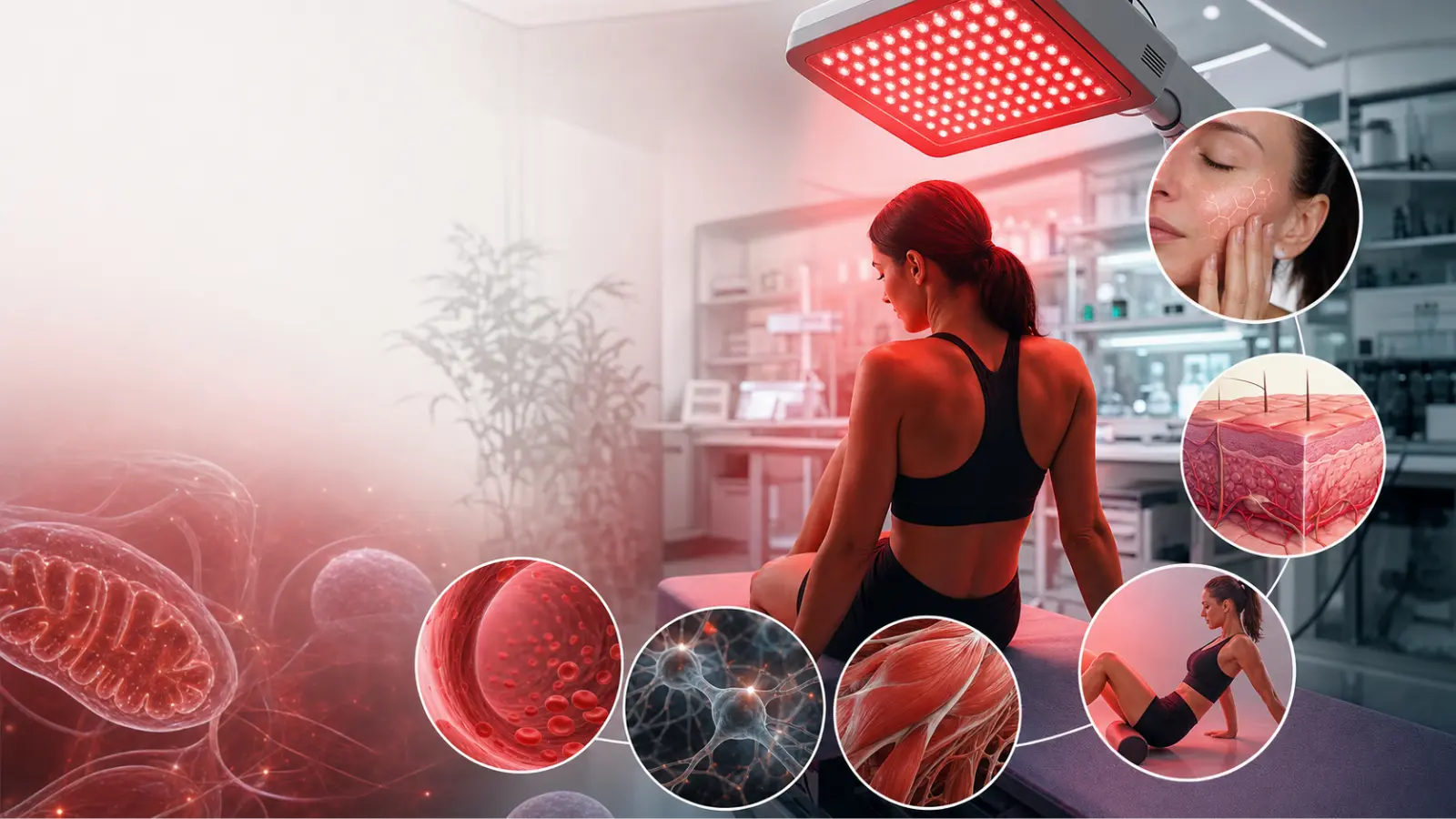
Mitochondria are the energy producing structures inside cells. They are especially important in tissues with high energy demand, including the retina, brain, muscle, and skin.
Older explanations often focused on cytochrome c oxidase, an enzyme in the mitochondrial electron transport chain. That mechanism is still relevant, but Jeffery’s discussion was broader. He emphasized that longer wavelength light may also interact with water inside mitochondria, potentially changing mitochondrial efficiency and ATP production.
Better Way to Say It
Red light therapy is not simply “red light hits one enzyme and ATP goes up.” A more accurate explanation is that red and near infrared light appear to influence mitochondrial behavior through multiple overlapping pathways.
Key Point 2: The Eye Is One of the Strongest Human Models
Jeffery’s most direct human research focuses on the retina.
That makes sense because photoreceptors are among the most metabolically demanding cells in the body. As we age, mitochondrial performance in the retina declines, and visual performance may decline with it.
In Jeffery’s 670nm studies, brief exposure to deep red light improved certain measures of visual function in adults over 40.
This is why his work is so important. It connects a specific wavelength, a specific tissue, a plausible mechanism, and a measurable human outcome.
Key Point 3: Modern LED Lighting May Be Missing Something Important
One of the more provocative parts of the episode was Jeffery’s criticism of modern LED lighting.
Many indoor LEDs are designed for efficiency, not biological completeness. They often produce enough visible light for human vision but lack much of the deep red, near infrared, and infrared light found in sunlight.
Jeffery argues that this matters because mitochondria are light sensitive.
Sunlight is broad spectrum. Most indoor LED lighting is narrow spectrum. Human biology evolved under sunlight, not under modern indoor LEDs.
That does not mean every LED bulb is dangerous. It means our indoor lighting environment has changed dramatically, and the missing long wavelength light may matter more than most people realize.
What Not to Overclaim
It is reasonable to say that modern LED light differs from sunlight and may lack biologically relevant long wavelengths. It is too strong to say LED lighting is destroying everyone’s mitochondria or that red light therapy reverses all LED related damage.
The more balanced takeaway is this: modern indoor lighting may be biologically incomplete, and longer wavelength light deserves more attention.
Evidence Strength Meter
| Claim | Evidence Strength | Notes |
| 670nm red light may improve some age related visual function | Strong for Jeffery’s specific eye research | Best supported in adults over 40 using specific protocols |
| Red and near infrared light can influence mitochondrial function | Moderate to strong | Mechanism is plausible, but not limited to one pathway |
| Red light therapy may help muscle recovery and pain | Moderate | Supported by broader PBM literature, but dose and device matter |
| Modern LED lighting may affect visual performance | Emerging to moderate | Jeffery’s work supports concern, but consumer conclusions should be cautious |
| Red light therapy corrects all damage from LED lighting | Weak | Too broad and not proven |
| More powerful devices are always better | Weak | Dose response is not linear |
Key Point 4: Wavelength Specificity Matters
Jeffery’s research focuses heavily on 670nm deep red light, especially for eye health and aging retinal function.
That does not mean 670nm is the only useful wavelength. It means 670nm has strong evidence in a specific context.
For general red light therapy use, different wavelength ranges are used for different goals.
Red Light Therapy Wavelength Chart
| Wavelength Range | Category | Common Use Case | Practical Meaning |
| 630 to 670nm | Red light | Skin, surface tissue, eye focused research | Strong relevance for superficial tissue and mitochondrial signaling |
| 660 to 670nm | Deep red | Jeffery style mitochondrial and eye research | Closest range to Jeffery’s most discussed work |
| 810 to 850nm | Near infrared | Muscle, joints, deeper tissue | Better penetration for recovery and pain applications |
| 830 to 850nm | Near infrared | Full body panels and recovery devices | Common in many PBM studies and consumer panels |
This is why many full body panels combine red and near infrared wavelengths. Red light covers more superficial tissue and skin related targets. Near infrared gives better penetration for muscle, joint, and deeper tissue applications.
Key Point 5: More Time Is Not Always Better
Jeffery’s eye studies used very short exposure times, sometimes just a few minutes.
That does not mean every red light therapy session should be three minutes. Eye protocols are different from full body panel protocols. A small 670nm eye exposure is not the same as standing in front of a large red light panel.
But the bigger lesson is important:
More red light is not always better.
Red light therapy appears to follow a biphasic dose response. Too little light may do nothing. The right amount may help. Too much may reduce the benefit or increase irritation.
For most home users, consistency and appropriate dosing matter more than chasing the highest possible irradiance.
What This Means for Choosing a Red Light Therapy Device
The Huberman and Jeffery episode gives consumers a useful framework for evaluating red light therapy devices.
For general home use, a strong device should include both red and near infrared wavelengths.
Red light in the 630 to 670nm range is especially relevant for skin, surface tissue, and Jeffery style mitochondrial research. Near infrared light in the 810 to 850nm range is more relevant for deeper tissue, muscle, joints, and recovery.
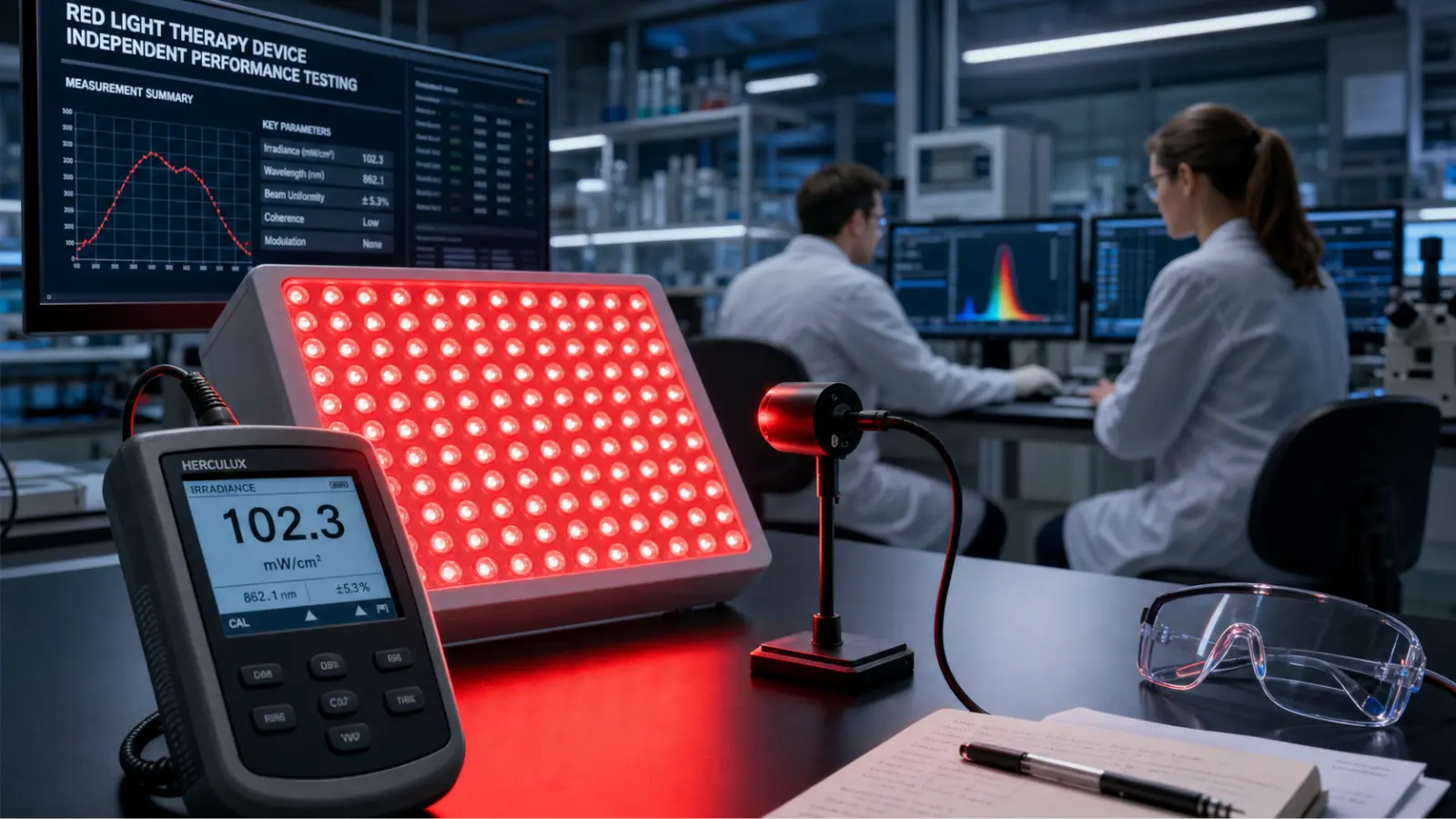
A good device should also publish real testing data. That includes wavelength confirmation, irradiance measurements, and realistic treatment distance guidance.
Red Light Therapy Device Checklist
Before buying a red light therapy device based on the Huberman and Jeffery discussion, look for these basics:
- Includes red light in the 630 to 670nm range
- Includes near infrared light in the 810 to 850nm range if you want deeper tissue coverage
- Publishes wavelength data, not just marketing claims
- Publishes irradiance or output testing at realistic treatment distances
- Gives clear dosing guidance for time and distance
- Is practical enough that you will actually use it consistently
- Avoids exaggerated claims like “reverses LED damage” or “works for everything”
Tips for Applying This Episode at Home
Start with shorter sessions and build consistency before increasing time.
Match the wavelength to the goal. Skin, muscle, joints, and eyes require different thinking.
Do not stare into standard body panels. Eye focused research does not mean every red light device is designed for direct eye exposure.
Check the company’s published testing. Device claims should be backed by wavelength and irradiance data.
Do not chase maximum irradiance. Higher power does not automatically mean better results.
Where We Agree With Jeffery
Jeffery’s biggest contribution is that he makes the mitochondrial case for light biology easier to understand.
Red light therapy is not magic. It is not just heat. It is not simply a wellness trend. There are plausible mechanisms and measurable human outcomes, especially in eye related research.
We also agree that modern indoor lighting deserves more scrutiny. Most people spend the majority of their time indoors under artificial light, while getting far less sunlight and long wavelength light than previous generations.
That is a major environmental shift.
Where We Would Add Context
The strongest evidence from Jeffery’s lab is not the same thing as a blanket endorsement of every red light therapy claim.
Eye health protocols are different from skin protocols. Skin protocols are different from muscle recovery protocols. Muscle recovery protocols are different from sleep, inflammation, and systemic wellness claims.
The best conclusion is not:
“Red light therapy works for everything.”
The better conclusion is:
“Specific wavelengths, delivered at appropriate doses, can influence mitochondrial biology and may support specific outcomes depending on the tissue, protocol, and device quality.”
Pros and Cons of the Huberman and Jeffery Red Light Therapy Takeaway
Pros
- Brings red light therapy into a more serious scientific conversation
- Explains why mitochondria are central to photobiomodulation
- Highlights the importance of specific wavelengths, especially 670nm
- Pushes back against the idea that longer sessions are always better
- Raises useful questions about modern indoor LED lighting
Cons and Limitations
- Jeffery’s strongest human evidence is focused on eye health, not every red light therapy use case
- The LED lighting argument is compelling, but easy to overstate
- A podcast discussion does not validate every consumer device
- Full body panel dosing is different from eye focused research protocols
- The mitochondrial mechanism is likely more complex than one single pathway
Our Take
The Huberman and Jeffery episode is one of the most important mainstream conversations about red light therapy so far.
It does not prove every claim in the industry. It does not mean every device is worth buying. It does not mean red light therapy replaces sunlight, sleep, exercise, or medical care.
But it does validate a key idea:
Light is a biological input.
The best takeaway is simple. Red and near infrared light therapy makes the most sense when you use the right wavelengths, the right dose, and a device that actually delivers what it claims.
For full body use, we generally prefer panels that combine red and near infrared wavelengths, publish testing data, and are easy to use consistently. The Mito Red Light MitoADAPT 4.0 series fits that framework because of the specialized mode settings for fine tuning the spectrum of light. It also includes clinically common red and near infrared wavelengths and the company publishes testing data for its panels.
Bottom Line
Andrew Huberman’s conversation with Dr. Glen Jeffery did not turn red light therapy into a miracle cure. It did something more useful.
It showed why wavelength, mitochondria, dose, and modern lighting environments deserve serious attention.
That is the real story.
Affiliate Disclosure
Some links on this page are affiliate links. If you purchase through them, we may earn a small commission at no extra cost to you. This helps support our independent reviews and research based content.
FAQ
What did Andrew Huberman’s guest say about red light therapy?
Dr. Glen Jeffery explained that certain wavelengths of red and near infrared light can interact with mitochondrial biology. His work is especially focused on 670nm deep red light and aging visual function.
Is 670nm the best red light therapy wavelength?
670nm is one of the most important wavelengths in Jeffery’s eye focused research, but it is not the only useful wavelength. For general red light therapy, 630 to 670nm red light and 810 to 850nm near infrared light are both commonly used.
Does red light therapy work through mitochondria?
Yes, red and near infrared light appear to influence mitochondrial function. The mechanism may involve cytochrome c oxidase, mitochondrial water, ATP production, and other overlapping pathways.
Are LED lights harmful?
Modern LED lighting is different from sunlight because it often lacks deep red and infrared wavelengths. Jeffery’s work suggests this may matter, but it would be too strong to say all LED lighting is harmful.
How long should red light therapy sessions be?
Session length depends on the device, distance, wavelength, and goal. Jeffery’s eye studies used very short exposures, but full body panel protocols are usually different. The key point is that more time is not always better.