
Quick Answer
Seeing a temporary blue, green, or cyan tint after red light therapy is usually caused by chromatic adaptation. Bright red light can reach the eyes through closed eyelids or around small silicone eye cups, temporarily shifting color perception. The effect should fade as your vision readjusts.
Why Everything Looks Blue After Red Light Therapy
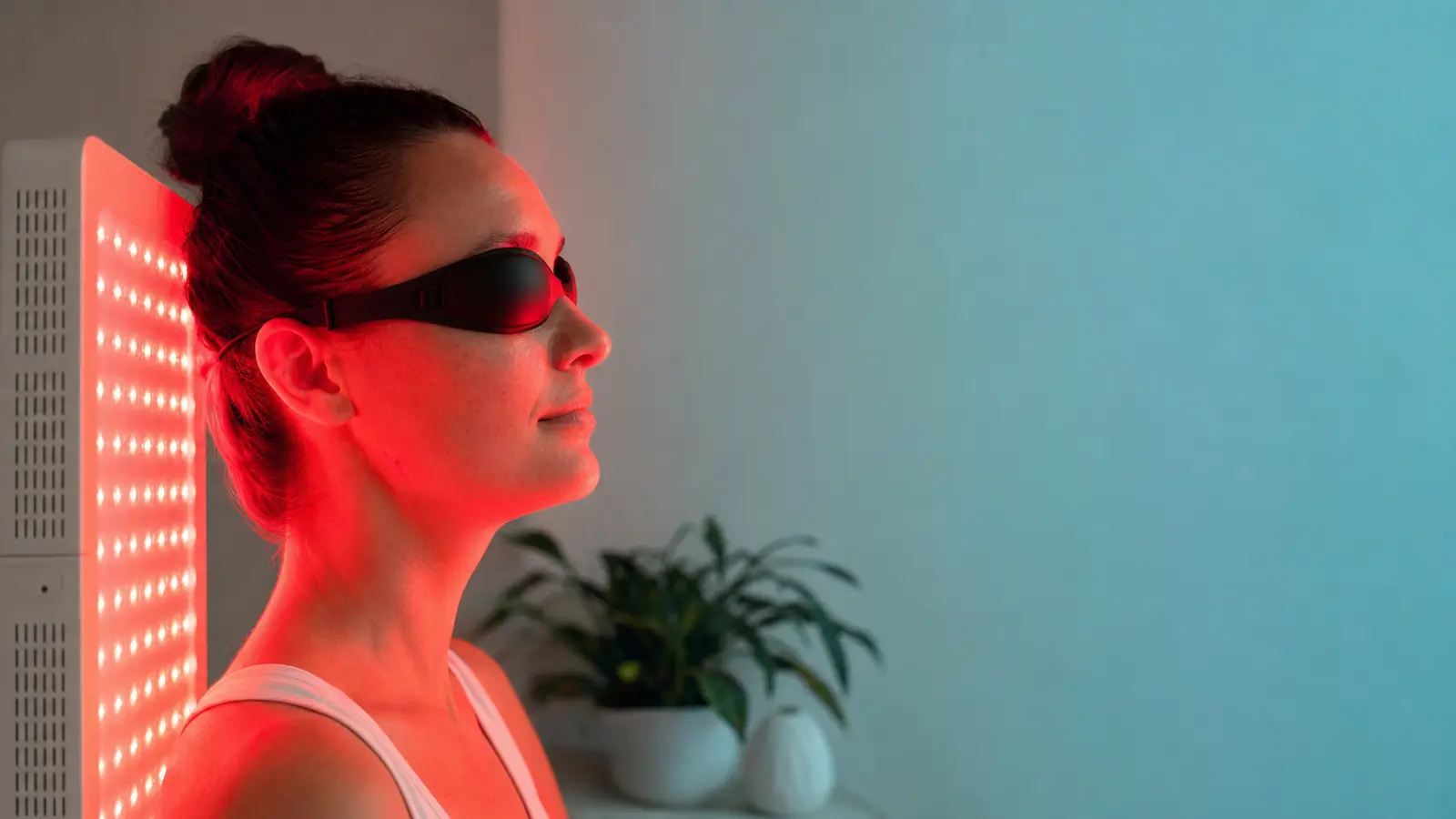
A red light therapy panel can fill much of your visual field with intense red light, even when your eyes are closed. Light may still pass through the eyelids or enter around the edges of small eye cups.
As the visual system adapts to this red dominant environment, the cone pathways most responsive to red temporarily become less sensitive. When you return to normal white light, color balance can briefly shift toward the opposing blue, green, or cyan tones.
After red light therapy, normal room lighting may briefly appear:
- Blue
- Blue green
- Cyan
- Greenish
- Cooler than normal
This is similar to staring at a brightly colored image and then seeing its complementary color when you look at a white wall.
What Is Chromatic Adaptation?
Chromatic adaptation is the visual system’s ability to adjust to the color of the surrounding light.
It is what allows a white object to continue looking approximately white under sunlight, indoor lighting, or a warmer lamp. Your eyes and brain continually recalibrate color perception based on the lighting environment.
A red light therapy session creates a much more strongly colored environment than ordinary room lighting. If enough red light reaches the retina, the adaptation can become noticeable when the session ends.
Research on human color vision shows that recovery from strong chromatic adaptation begins quickly and may occur over the following minutes, although the exact duration depends on the exposure and the person.
Chromatic Adaptation Versus a Negative Afterimage
These effects are closely related, but they describe slightly different parts of the same visual response. Chromatic adaptation refers to the broader adjustment to a red dominated environment, while a negative afterimage is the blue, green, or cyan tint you may notice after looking away.
Chromatic Adaptation vs. Negative Afterimages
| Term | What It Means | What You May Notice |
|---|---|---|
| Chromatic adaptation | The visual system adjusts to a dominant color environment | Normal surroundings temporarily look cooler or shifted in color |
| Negative afterimage | An opposing color remains visible after looking away from a bright color | A blue, green, or cyan image or haze |
| Light adaptation | The eyes adjust to overall brightness | Temporary dimness, glare, or reduced contrast |
| Persistent visual disturbance | A color or image change that does not resolve normally | Ongoing spots, flashes, distortion, pain, or one sided symptoms |
In real world red light therapy use, the temporary blue cast may involve both chromatic adaptation and a negative afterimage. There is no need to force a strict distinction when explaining the experience to a consumer.
Why Closing Your Eyes May Not Prevent It
Closing your eyes reduces direct visual exposure, but it does not create a complete blackout.
Studies measuring eyelid transmission have found that the eyelid behaves partly like a red pass filter. It blocks much of the shorter wavelength visible light while allowing a greater proportion of red light to pass through. Reported transmission varies considerably between studies and individuals, but the overall pattern is consistent: closed eyelids do not completely block bright red light.
You can often confirm this yourself without looking directly at the panel. Close your eyes near a bright red light therapy device and you may still see an intense red glow.
The effect becomes more likely when:
- The panel has high irradiance
- You are positioned close to the LEDs
- Red wavelengths are used at full brightness
- The session is relatively long
- Eye protection leaves gaps around the eye socket
The Problem With Small Silicone Eye Cups
Many red light therapy panels include small silicone or rubber eye cups. These may make the session more comfortable, but they do not always block all light reaching the eyes.
The cups may cover the eyelids while leaving open space around:
- The inner corners of the eyes
- The outer corners of the eyes
- The upper eye socket
- The lower eye socket
- The bridge of the nose
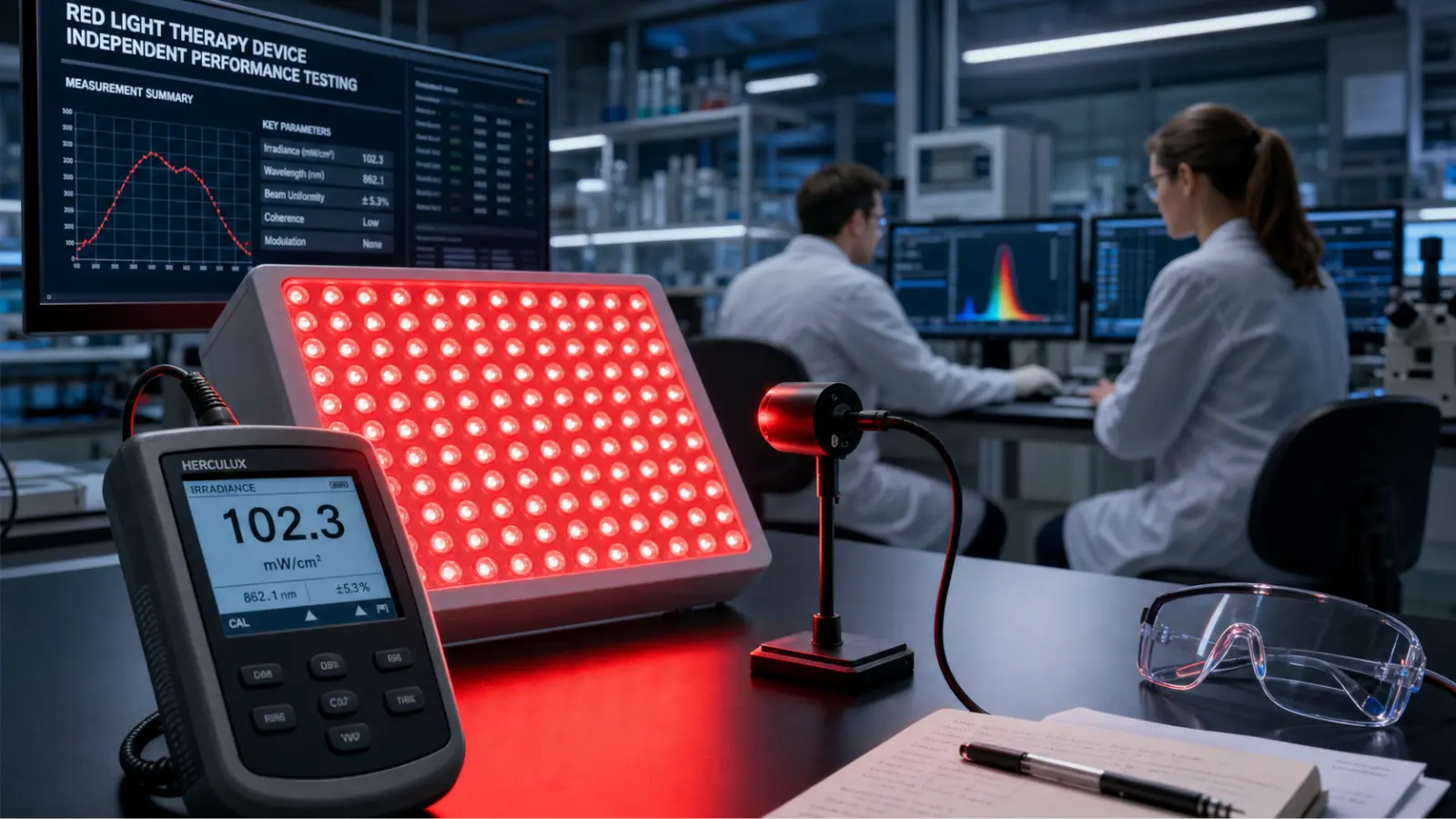
A higher-irradiance panel, often measuring roughly 40 to 100+ mW/cm² at a 6-inch treatment distance, can strongly illuminate the skin around gaps in small eye cups. Visible red light may then reach the eyes through the closed eyelids or around the edges of the protection.
This is why someone may experience a blue or green afterimage even though they wore the eye protection included with the device.
It does not necessarily mean the cups are defective. They may have been designed mainly to reduce brightness and discomfort rather than create a completely light sealed environment.
Does Higher Irradiance Make the Effect More Likely?
Irradiance describes how much optical power reaches a given area. As the panel becomes brighter at the eye, the visual system receives a stronger adapting stimulus.
Factors That Increase Eye Exposure During Red Light Therapy
| Factor | Likely Effect on the Color Shift |
| Moving closer to the panel | Increases the light reaching the eye |
| Increasing brightness | Creates a stronger adapting stimulus |
| Using more visible red light | Makes the red environment more dominant |
| Extending the session | Gives the visual system more time to adapt |
| Using fully light blocking goggles | Reduces visible light reaching the eyes |
This does not provide a precise threshold at which chromatic adaptation will occur. Different panels have different LED layouts, beam angles, wavelengths, brightness controls, and measured outputs. People also vary in visual sensitivity.
Is the Blue Color Shift a Sign of Eye Damage?
A brief color afterimage that fades soon after exposure is not the same thing as proof of retinal damage.
Chromatic adaptation is a normal feature of the visual system. Temporary afterimages can occur after many bright visual exposures, including camera flashes, stage lighting, sunlight reflected from a surface, and brightly colored screens.
However, the presence of a temporary afterimage also should not be used as proof that every exposure level is safe.
Photobiological safety depends on more than whether a device uses red light. It can also depend on wavelength, radiance, exposure duration, viewing distance, beam geometry, pulsing, and whether someone looks directly at the source. International lamp safety standards use detailed optical measurements because evaluating an extended LED source is more complicated than judging brightness by appearance alone.
A better conclusion is:
A brief blue or green color shift is consistent with normal visual adaptation, but it is still a sign that a meaningful amount of visible red light reached the eyes.
What To Do If You See Blue After a Session
Post Session Checklist
✓ Turn away from the panel and return to normal room lighting.
✓ Give your vision several minutes to readjust before driving or doing visually demanding work.
✓ Avoid repeatedly checking the effect against a bright white screen.
✓ Note the panel brightness, distance, session length, and eye protection used.
✓ Reduce the amount of visible light reaching your eyes during the next session.
The color shift should become progressively less noticeable as normal color balance returns.
How To Reduce Chromatic Adaptation
You do not necessarily have to stop using your panel. The goal is to reduce how much visible red light reaches the eyes by covering the entire eye socket, not just the eyelids.
Small silicone eye cups can leave gaps around the nose, brow, and outer corners of the eyes, allowing light to enter from the sides. Larger blackout style goggles or glasses with dark protective shaders may provide more complete coverage and reduce the chance of a temporary color shift.
Featured Eye Protection: Mito Red PRO Glasses
For users who want more coverage than small silicone eye cups, the Mito Red PRO Glasses are designed to reduce red and near infrared light across the 600 to 900 nm range. Extended side shaders help reduce light entering around the nose, brow, and outer edges of the eye socket, where basic eye cups may leave gaps.
The compact lens design protects the eyes while leaving more surrounding facial skin exposed to the treatment light.
IR3 PRO Dark: Reduces light by approximately 80 percent and is designed for most red light therapy users.
IR5 PRO Extra Dark: Reduces light by approximately 95 percent and may be better suited to very bright panels, close treatment distances, or users who are more sensitive to light.
The lightweight, anti scratch frame provides broader coverage around the eye socket than basic silicone cups and may help reduce glare and the temporary color shift associated with chromatic adaptation.
Best for: Panel users who want improved coverage around the eye sockets without using large blackout goggles.
Other Ways to Reduce Chromatic Adaptation
1. Use Blackout Style Eye Protection
Choose eye protection that covers more of the eye socket and blocks light around the edges.
Small tanning style eye cups may reduce glare but still allow substantial peripheral exposure. Larger blackout goggles or a properly fitted opaque sleep mask may block more light.
Make sure the product is appropriate for the device and does not cause you to violate the manufacturer’s safety instructions.
2. Increase Your Distance
Moving farther from the panel generally reduces the light reaching your face and eyes.
The change in actual irradiance depends on the panel’s beam angle and LED configuration, so do not assume every panel follows a perfect mathematical relationship.
3. Lower the Visible Red Brightness
Some modern panels allow separate control of red and near infrared wavelengths.
Reducing the visible red setting may decrease the color adaptation effect. Near infrared is not visible, but that does not mean it should automatically be treated as risk free for direct ocular exposure. Follow the device instructions and avoid deliberately staring at active LEDs.
4. Shorten the Session
A shorter exposure gives the visual system less time to adapt to the red field.
This may be especially useful if the blue cast appears only during longer full body sessions.
5. Change Your Position
You may not need to face directly toward the panel for every treatment goal.
For treatments involving the back, legs, or side of the body, position the panel so the LEDs are outside your direct line of sight.
Red Light Therapy Eye Protection Options: Pros and Cons
| Option | Pros | Cons |
| Eyes closed only | Convenient and does not block facial coverage | Red light can still pass through the eyelids |
| Small silicone eye cups | Comfortable, inexpensive, and commonly included | May leak light around the eye socket |
| Blackout goggles | Better visible light reduction | Can block treatment of skin around the eyes |
| Opaque sleep mask | Covers a larger area and may reduce edge leakage | Fit and materials vary |
| Facing away from the panel | Strongly reduces direct visual exposure | Not practical for every treatment position |
When the Effect May Be More Noticeable
Not everyone experiences the same degree of blue or green vision.
The effect may be stronger when you:
- Use a powerful panel close to your face
- Treat in a dark room
- Use visible red light at maximum intensity
- Complete a long session
- Immediately look at a white wall, phone, or computer screen
A dim room can make the panel appear more visually dominant because the eyes are adapted to lower background lighting before the treatment begins.
When To Seek Medical Advice
Stop the exposure and contact an eye care professional if the visual change:
- Does not steadily improve
- Persists much longer than your usual afterimage
- Occurs in only one eye
- Is accompanied by pain, severe headache, flashes, new floaters, blind spots, or distorted vision
- Begins without a clear bright light exposure
Flashes, persistent bright spots, and other ongoing visual disturbances can have causes unrelated to red light therapy and should not automatically be labeled chromatic adaptation. The American Academy of Ophthalmology advises evaluation for concerning visual symptoms, particularly when they are new, persistent, or associated with additional changes in vision.
Quick Takeaway
The temporary blue or blue green cast some people notice after red light therapy is most consistent with chromatic adaptation and a complementary color afterimage.
It happens when enough visible red light reaches the retina to temporarily shift the visual system’s color balance. Closed eyelids reduce exposure but do not block all red light. Small silicone eye cups can also leave gaps around the eye socket, particularly during close, high irradiance panel sessions.
The effect should fade as the eyes readjust. Better fitting blackout protection, greater treatment distance, lower visible brightness, and shorter sessions may reduce it.
A temporary afterimage is not automatic proof of damage, but persistent or unusual visual symptoms deserve professional evaluation.
FAQ
Why does everything look blue after red light therapy?
Bright red light temporarily adapts the color vision system to a strongly red environment. When you return to normal white light, the opposing blue or green component can briefly appear stronger.
Can this happen with my eyes closed?
Yes. Eyelids attenuate light but do not completely block it. Red wavelengths pass through closed eyelids more readily than many shorter visible wavelengths.
Are the silicone goggles included with my panel enough?
They may reduce brightness, but small eye cups do not always create a full light seal around the eye socket. If you continue to see a strong red glow or experience color adaptation, consider more complete blackout protection.
How long should the blue vision last?
A typical adaptation effect should begin fading within minutes, although recovery can vary with exposure intensity, duration, and individual sensitivity. Research under controlled adaptation conditions has documented recovery over the following several minutes.
Should I stop using red light therapy if this happens?
Not necessarily. First reduce the visible light reaching your eyes by improving eye coverage, increasing distance, lowering brightness, or shortening the session. Stop and seek professional advice if the change persists, worsens, causes pain, or differs between the two eyes.
Research Links
Recovery From Chromatic Adaptation in Human Vision
This human study examined how color perception recovers after exposure to strongly colored adapting light.
View the study on PubMed
Central Visual Adaptation to Chromatic Light
This research explores how adaptation to colored light involves both retinal and higher-level visual processing.
View the study on PubMed
How Human Color Vision Works
This NCBI reference explains cone photoreceptors and the opponent pathways involved in red-green and blue-yellow color perception.
Read the NCBI overview
Photobiological Safety of Lamps and LED Systems
This CIE resource explains why eye safety depends on wavelength, exposure time, source geometry, and measured output.
Read the CIE guidance